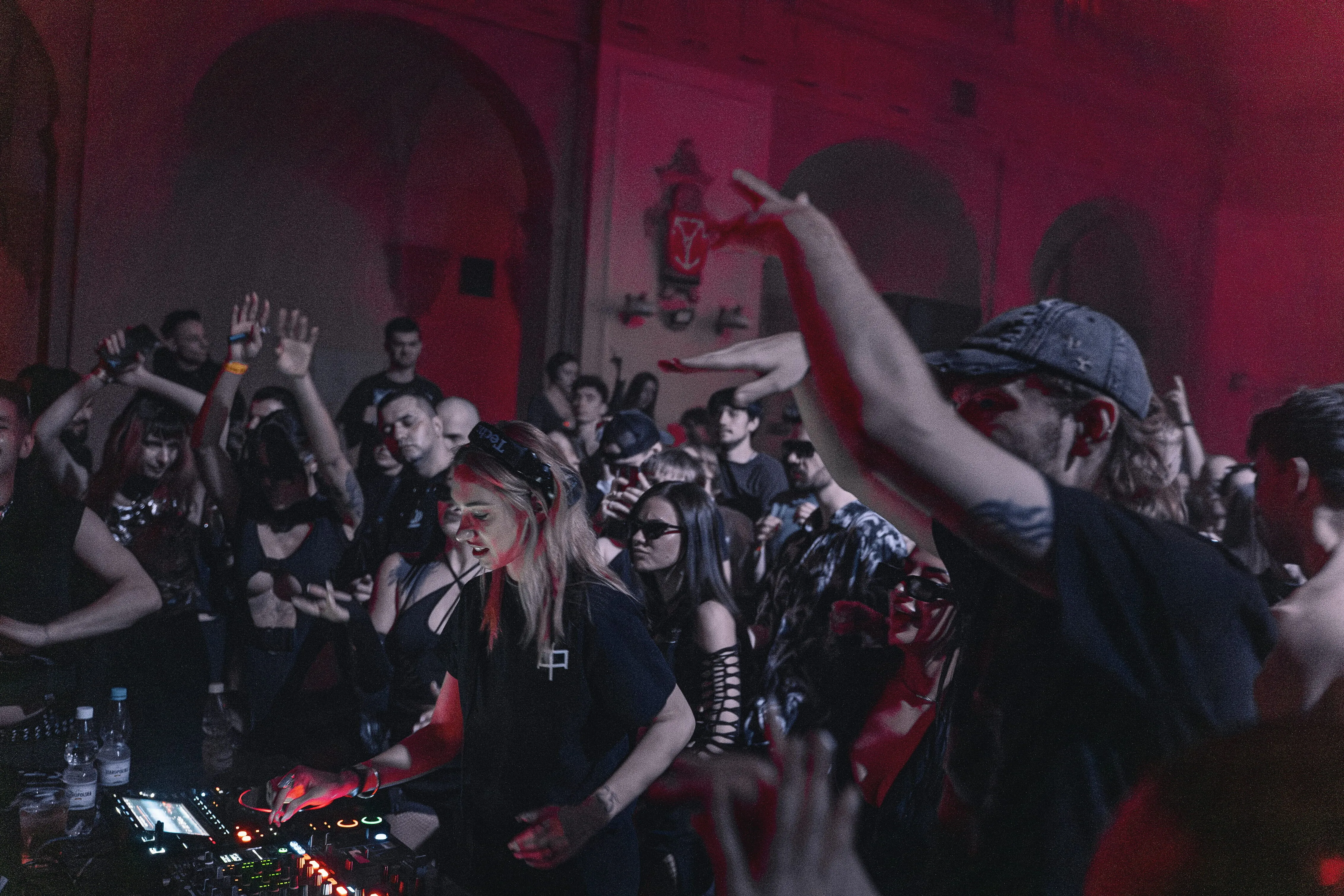
Sournois is a DJ who has been an active part of our scene since 2019. She doesn't limit herself to just one style, effortlessly shifting between ghetto-house and euphoric trance. Five years ago, she took 3rd place as "Discovery of the Year" in the Munoludy awards. Since then, her gigs have included sets at Georgia’s Khidi and the legendary Tresor in Berlin.
To celebrate her win, we asked Sournois a few questions.
Artur Wojtczak: When and how did your musical journey begin—first as a raver, and then as a DJ?
Sournois: It was 2017. Audioriver, Klub Mózg in Bydgoszcz, Wixapol, and Smolna—that was the exact order of my first electronic music events. For a start, the variety of genres and vibes was pretty huge! (laughs)
I bought my Audioriver ticket blindly, persuaded by friends, so I was thrown straight into the deep end. Klub Mózg is located in my hometown, so whenever I went back to Bydgoszcz for holidays or weekends, I often ended up there. Wixapol was going through its golden era back then (which continues to this day) and really stood out on the scene—both with its parties and its flashy marketing. At the time, a lot of old-school purists hated them. Now they probably have other enemies to worry about.
Near the end of 2017, I visited Smolna for the first time. That was right around the time Bicep released their track "Glue". I heard it on the dancefloor for the very first time that night, and I still remember that moment vividly. A few years later, I was determined to look up which locals were playing that night. It turned out to be Truant and MKO.
In 2018, I decided to buy my first DJ controller. I told my dad about it, and since it happened to be July—my birthday month—he ended up buying it for me as a gift. For a long time, I was mostly self-taught, practicing at home.
In 2019, I moved to Wrocław for university. That's when I met Kajetan, who was building a skate bowl inside the Transformator club (which now operates as Final Bowl Skatepark in a completely different location). Thanks to him, I met the local crew, and that's where I landed my first gig. I played at the afterparty for a skateboard movie premiere, which you can still find on YouTube today.
Did winning the Burn Energy competition, organized jointly with Mixmag -which received a ton of submissions - come as a surprise to you?
Yes, absolutely. After filling out the application form myself, I sent it to a dozen friends and urged them to enter because it was the final week before the deadline. The odds of winning with that many entries seemed slim, but clearly, they weren't zero.
I actually expected someone with less experience than me to win. Competitions like this usually focus on discovering completely new faces, so I was even more surprised when I saw the results. It made me all the happier because I took it as a sign that what I’ve been doing for the past few years has been noticed and appreciated.
How do you usually prepare for a club gig?
I’ve actually had the exact same routine for years. I dig for music, buy, and download new tracks almost every day, so I try to keep my playlists as fresh as possible.
The subsequent preparation depends entirely on the type of gig. Selecting music for an outdoor party in the woods will look completely different from a set played in a dark, smoky club basement. I always try to match the music to the venue, the crowd, and the vibe of the event.
At the same time, I have a few tracks that have stuck with me for 7 years. I treat them a bit like my signature—tracks that I closely associate with my style of playing. I’ll also honestly admit that I’ve managed to play a few sets using the exact same playlist.
You lived in Georgia for a year, giving you the chance to experience their highly vibrant scene. How does it differ from the Polish one, and what would you bring over to our ground?
The grass is always greener on the other side, I want to emphasize that right from the start.
I don’t know if you remember, Artur, but a year ago I told you that after my one-year stay in Georgia, I started writing an op-ed about their club scene. I even asked you for help with publishing it back then. The text is still sitting unfinished on my hard drive, but maybe right now is a good time to get back to it. It’s really a topic for a separate article. However, if I had to boil it down to a few keywords, they would be: sound system, politics, protests, and a sense of community.
Let's start with the sound system. Georgia has only four cities with a population of over 100,000. Why do I mention this? I’ll get back to that.
It doesn't matter if we're talking about Bassiani, a small pub under a bridge in Tbilisi, or a club in Kutaisi (a city of about 100,000 people right in the center of the country). A Void or Funktion-One system is the standard everywhere. This was a huge surprise to me because Georgia is a much poorer country than Poland, yet sound quality seems to be an absolute priority there.
By comparison, in Poland, we have 34 cities with a population over 100,000. Our scene is much larger, more scattered, and therefore more diverse. Of course, you can find clubs with top-tier sound systems, but you’ll also find those operating on much tighter setups. If I'm looking for a specific standard, I can find it, but I usually have to travel to another city.
At the same time, I believe we have many truly fantastic sound and production specialists in Poland, alongside a massive number of exceptionally high-level events, such as EXIST. Just look at the wide array of festivals we have, ranging from the more mainstream to strictly electronic ones.
It’s also worth mentioning the people behind all of this, like Karol from Slap Sound System. If you spot a guy at an event wearing a beret and shorts, holding a tablet, pacing around the dancefloor and constantly listening out for things, there's a good chance it's him. Massive respect is due here, because thanks to people like him, the sound quality at many Polish events is at a very, VERY high level.
That's why I wouldn't want to create a narrative that everything works better in Georgia. It’s simply a different reality. What surprised me there was that even in smaller venues, a high sound standard is taken for granted. In Poland, on the other hand, I'm impressed by the sheer scale. If you have the funds and some free time, you could practically spend the whole summer traveling from festival to festival. In that regard, our country offers an incredible amount of choice.
Moving on to politics, protests, and the sense of community - this is where I see the biggest difference between the Georgian and Polish scenes.
I lived in Georgia throughout 2024. At first, everything seemed relatively peaceful. People were smiling, clubs were full of life, and in venues like Bassiani, you could feel a unique energy and pride in what they had managed to build over the recent years.
The situation began to change in the spring of 2024, when the government resumed work on the "foreign agents" bill, dubbed the "Russian Law" by its opponents. In practice, many people saw it as an attempt to copy Russian tactics aimed at restricting independent organizations and media. Protests erupted immediately and very quickly became a part of daily life.
My friends told me about the war in the 90s that followed the collapse of the USSR, and later about the war with Russia in 2008 and the occupation of Abkhazia and South Ossetia, which continues to this day. For many people, these were not abstract events from a history textbook, but personal experiences shared by their families.
A few friends also told me about their childhood in the 90s and early 2000s. About how electricity was sometimes only available for a few hours a day, and how daily life was full of uncertainty and chaos. For someone raised in Poland, it sounds almost unbelievable. Even if our childhoods weren't perfect, we grew up under completely different conditions. I think that's exactly why the Georgian club scene has slightly different roots compared to the Polish one. Of course, for many people, a club remains a place to have fun, but at the same time, it’s something more—a space for freedom, self-organization, and social resistance. In Poland, electronic music is mostly associated with escaping daily life, finding your crowd, and being a place where you can just be yourself. In Georgia, there's an added political dimension.
This is best captured by the slogan "We Dance Together, We Fight Together," which was born after police raids on Bassiani and Cafe Gallery in May 2018. Back then, thousands of people took to the streets outside the parliament, and the building's steps turned into a dancefloor. That was the moment electronic music became a symbol of the fight for freedom, equality, and the right to one's own culture. During the 2024 protests, that spirit was still very much alive. Clubs scaled back their operations, posted announcements encouraging people to join the demonstrations, and reminded everyone that the dancefloor's energy could be carried onto the streets.
I lived on Rustaveli Avenue, literally a dozen minutes' walk from the parliament. I attended most of the protests. I saw demonstrators being detained, felt pepper spray in my nose, got soaked by water cannons, and felt the daily tension between residents and the police. A few of my friends later faced legal issues related to their participation in the protests and political activism.
And it was that sense of community that I envied Georgians for the most. It's not about everyone liking each other or always agreeing. It’s more about the conviction that in crucial moments, they can stand side by side and act together.
At the same time, I don’t want to romanticize this situation. As a Pole, I wouldn't trade our relative peace and sense of security for a more "underground" club scene. Behind the energy we witness in Georgia, there are often very difficult experiences, uncertainty, and a real fear for the country's future.
Besides, we also know how to unite. This was shown, for example, by the protests following the Constitutional Tribunal's ruling on abortion, and many other moments in Poland's recent history. The difference is that for us, such mobilizations are exceptions, whereas in Georgia over the past few years, they have become part of daily life.
And I guess that's exactly what my stay in Tbilisi taught me—that a club scene can be about something much bigger than music, and over there, it is deeply intertwined with politics.
I took that booking as a massive honor, and I hope to return there someday.
I brought a group of friends with me on the trip, and another part of our crew was already waiting for us in Berlin. It was one of those moments that you experience together and remember for a long time. All the DJs playing that night delivered incredibly high-level sets, so I’m all the happier that I could be a part of that lineup.
I was invited to Tresor by the Georgian artist Ly Sas. We are similar in age, yet she already has a release on the label of Fiedel, a resident of Berghain and formerly Ostgut Ton. That made the invitation itself feel even more special to me.
For years, Tresor has been one of the most important reference points on the global club map for me, so being able to play there was something I wouldn't have even imagined a few years ago.
What are your plans and musical dreams for the second half of 2026?
As for the plans for the second half of 2026, I already have a few confirmed dates for the fall. Among them, I’m particularly looking forward to performing at club HALL in Estonia. I really love traveling and playing in places that aren't necessarily obvious spots on the clubbing map. I hope that someday music will blow me away to Jakarta, Astana, or even somewhere in South America.
I’m also very curious about the electronic scene in China. I wonder what their underground looks like, how it functions under censorship, and what stories lie beneath what’s visible from the outside. Or rather, what isn't visible, since they use completely different social media platforms than we do.
When it comes to dreams, they aren't really things that can be achieved within six months. I won't mention obvious goals like "I want to play here and there." One of my most unusual dreams is to appear in a video game. Imagine CD Projekt creating a game where you play a character dreaming of a career as a DJ or producer, and one of the available characters is Sournois. How cool is that?!
It sounds unrealistic, but I’d be just as happy with a short cameo in GTA or Cyberpunk - just like artists such as Dixon, The Blessed Madonna, or Solomun have appeared before.
What is the most beautiful thing about club culture to you?
I ask myself this question every single time the alarm goes off at 3 AM and I have to get up to play a closing set. I’m still in awe of the contrasts that club culture brings. Once, I woke up, went to play a closing set right after Fjaak, and then went straight to university because I had a seminar for my thesis. The topic of my thesis was actually about club culture: "The Polish electronic music scene through the eyes of its audience—intentions versus reality." There was something absurd yet fascinating about sitting backstage at 8 AM after playing for a few hours, surrounded by cigarette smoke and post-party morning chatter. A moment later, I got into my car and drove to the university, where I talked with my professor about clubs' PR strategies, how the club scene managed during the pandemic, how the war in Ukraine affected the entire industry's marketing, and cancel culture.
Along the way, I had the opportunity to discuss my thesis topic with many people from the industry and beyond, which allowed me to look at it from different perspectives and learn a lot of interesting things.
I think the most beautiful thing about club culture is that despite different views, beliefs, or lifestyles - there is always one common denominator: the music that connects everyone at that exact same moment.
.webp)